


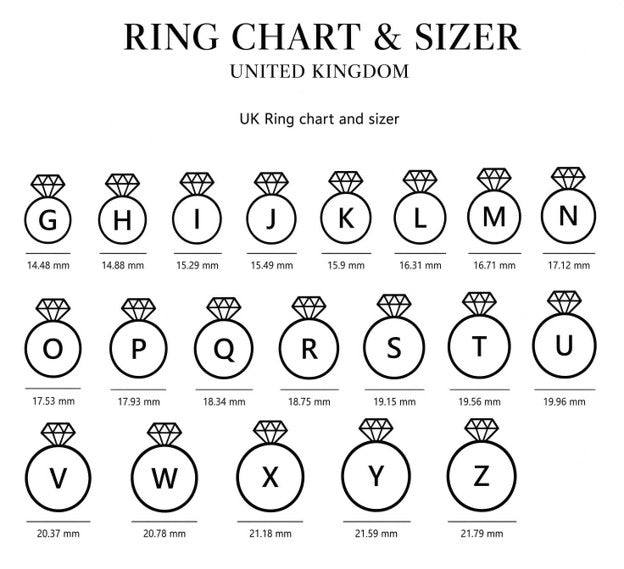
UK Ring Size Chart: Find Your Perfect Fit
Choosing a beautiful ring is only half the decision. Whether you are shopping for an engagement ring, a wedding ring or a new addition to your jewellery collection, getting the ring size right is critical for comfort, security and everyday wear.
A correctly fitted ring should slide comfortably over the knuckle with slight resistance before sitting securely at the base of the finger. It should not feel uncomfortably tight, but it should not spin excessively or feel as though it could easily slip off.
The challenge is that finger size can change throughout the day, different ring styles can fit differently and international sizing systems are not identical. This UK ring size chart guide explains how to measure your ring size, how UK sizing works and what to do if you are secretly trying to find a loved one's ring size.

Please note this is approximate sizing.
How Do UK Ring Sizes Work?
UK ring sizes use letters rather than the numerical system commonly found in countries such as the US. Sizes generally run from A through to Z, with additional sizes available beyond this range when required.
Each UK ring size corresponds to a particular internal diameter and circumference in millimetres. Most UK jewellers can also work with half sizes, giving you greater precision when a full size does not provide the perfect fit.
This is particularly useful for engagement rings and wedding rings that you may wear every day. Even half a size can make a noticeable difference to how comfortably a ring sits.
If you are comparing jewellery from different countries, a ring chart for converting ring sizes can help translate UK sizing into US or European measurements. However, having your finger professionally measured remains preferable when accuracy is particularly important.
What Is the Average Ring Size in the UK?
The average UK women's ring size is commonly around L to M, while the average men's ring size is generally around S to T.
These averages can provide a starting point, particularly when planning a surprise proposal, but they should never replace an actual measurement where one is available. Hands and fingers vary considerably, meaning two people with similar builds may have entirely different ring sizes.
Ring style can also affect the ideal ring size. Wider bands tend to feel tighter than thinner rings because more metal sits against the finger. As a result, a wider wedding band may need to be approximately half a size larger than a delicate engagement ring.
How to Measure Your Ring Size at Home
There are several ways to measure ring size at home, but accuracy is essential.
One simple method uses a flexible tape measure. Wrap it comfortably around the base of the correct finger and record the circumference in millimetres. You can then compare the measurement with a UK ring size chart.
If you do not have a suitable tape measure, use a narrow strip of paper. Wrap the paper around your finger, mark where the two ends overlap and lay it flat against a ruler. The length between the end and your mark gives you the approximate circumference.
Do not pull the paper or tape excessively tight. The finished ring needs to pass over your knuckle as well as fit the base of the finger.
For greater accuracy, a ring sizer or professional jeweller's sizing gauge is preferable.
How to Measure an Existing Ring
If you already own a ring that fits perfectly, measuring it can be one of the easiest ways to estimate your exact ring size.
Choose an existing ring worn on the same finger as your new ring. Place it on a flat surface and measure straight across the centre from one inside edge to the other. You are measuring the internal diameter, not the outside edges of the metal.
Record the diameter in millimetres and compare it with an accurate UK ring size chart.
This approach is particularly useful when buying a ring for somebody else, provided you know the existing ring fits the correct finger. A ring worn on the third finger of the right hand, for example, may not provide the correct size for the ring finger on the left hand.
When Is the Best Time to Measure Your Finger?
Your fingers are not exactly the same size throughout the day. Temperature, activity and natural fluctuations can cause them to expand and contract.
Warm fingers tend to swell slightly, while cold fingers can shrink. For this reason, avoid measuring immediately after coming in from extreme weather or when your hands are unusually hot.
Measuring towards the end of the day, when your hands are at a comfortable, normal temperature, can provide a useful indication of your everyday size. For the most accurate result, measure the finger several times on different days rather than relying on one reading.
How Should the Perfect Ring Fit?
The perfect ring should fit snugly without being uncomfortable.
It should slide over your knuckle with some resistance but should never require force. Once in position, the ring should sit securely without digging into the skin. Some movement is normal, but a properly fitted ring should not continually spin around your finger or feel at risk of slipping off.
If your measurement falls directly between two sizes, choosing the slightly larger size can often provide a more comfortable fit. However, the design of the ring matters, so professional guidance is useful before making the final choice.
With wider bands, going up half a size may provide additional comfort because of the greater amount of metal sitting against the finger.
How to Use a Printable Ring Size Chart
A printable ring size chart can be a convenient way to estimate your size at home, but it needs to be printed correctly.
Always make sure the document is printed at 100% or the actual size. Selecting options such as "fit to page" can alter the scale and produce an inaccurate result.
Some printable ring sizer tools allow you to place an existing ring over circles representing different sizes. Simply pop the ring over each circle until you find the one that matches its inside edge most closely.
Other printable tools can be cut out and wrapped around the finger. Again, check the printing scale before measuring.
If accuracy is critical, particularly for a valuable engagement ring , professional sizing remains the safest option.
How to Find Your Partner's Ring Size for a Surprise Proposal
Finding your partner's ring size without ruining an unforgettable surprise requires a little more creativity.
The most reliable approach is to temporarily borrow one of your loved one's rings. Make sure it is normally worn on the correct finger, then measure its internal diameter or take it to a jeweller for comparison.
You could also ask your partner's family or close friends whether they know the size. Someone may have previously bought them a ring or be able to find out naturally without making the reason obvious.
Another option sometimes suggested is pressing an existing ring gently into plasticine to create an impression of its inside edge, which can then be measured. While this method may provide an approximation, borrowing the actual ring is preferable whenever possible.
Trying to measure your partner's finger while they sleep is far less reliable than it sounds. Movement, pressure on the measuring material and the risk of waking them can all produce an inaccurate size. An existing ring or discreet help from family is generally a better approach.
If you genuinely cannot determine the exact ring size before proposing, please discuss resizing options with the jeweller before selecting the ring.
Does Ring Style Affect Sizing?
Yes. Ring style and band width can affect how a particular size feels.
A delicate diamond ring with a narrow band will usually feel less restrictive than a wide ring of exactly the same size. Wider bands cover more of the finger and can therefore require a slightly larger size for a comfortable fit.
The metal type does not directly determine ring size, but it can influence future resizing options. Some designs are much easier to resize than others.
Intricate diamond settings, stones positioned around the entire band, or certain contemporary designs may have more limited resizing options. This is worth considering before buying if you are uncertain about the size.
When browsing diamond engagement rings , consider the setting and band proportions alongside the stone and overall design.
Do Engagement Rings and Wedding Rings Need the Same Size?
Not necessarily.
An engagement ring and wedding ring are usually worn together on the same finger, but their individual widths and designs influence how they feel when stacked.
Two rings sitting together effectively create a wider area of metal around the finger. Someone who finds a slim engagement ring comfortable in one size may therefore need adjustments when choosing a broader wedding band.
If you plan to wear several rings together, try them as a complete stack where possible. Lords' in-store experts can help assess how different styles sit together and determine the size that offers the best combination of appearance and comfort.
What Happens If You Choose the Wrong Ring Size?
Choosing the wrong size does not necessarily mean choosing the wrong ring. Many rings can be professionally resized.
A jeweller may be able to make a ring larger or smaller depending on its metal, setting and design. Traditional plain bands and many solitaire designs are relatively straightforward, whereas highly detailed rings can be more complicated.
The amount by which a ring can safely be resized also varies. This is why it is worth discussing potential alterations with a jeweller rather than assuming every ring can be adjusted by several sizes.
If you are planning a proposal and only have an approximate size, choosing a design with practical resizing possibilities can provide additional reassurance.
Top Tips for Finding the Correct Ring Size
Accuracy comes from taking your time rather than relying on one quick measurement. Measure the correct finger more than once, preferably when your hands are at a normal temperature, and consider the width of the ring you intend to wear.
When using an existing ring, make sure it genuinely fits the intended finger. When using a printable ring sizer, always print it at actual size. If you find yourself between measurements, keep in mind that half sizes can offer a better fit.
Most importantly, seek professional advice when you are unsure. A jeweller's sizing gauge remains one of the most accurate ways to find your ring size because it allows you to physically test different sizes and assess how they move over your knuckle.
Ring Sizing FAQs
Are UK ring sizes different from US sizes?
Yes. UK ring sizes primarily use letters, while US sizing uses numbers. European sizing commonly uses numbers based on circumference. A guide for converting ring sizes can help compare the different systems, but slight variations can occur.
Which finger should I measure for an engagement ring?
In the UK, engagement rings are traditionally worn on the third finger of the left hand. Measure that specific finger because corresponding fingers on opposite hands can vary slightly in size.
Should I size up if I'm between ring sizes?
If your measurement falls between sizes, the slightly larger option may be more comfortable, particularly with wider bands. Half sizes can provide a more precise solution where available.
Can I measure my ring size with string?
You can, but a string can stretch or compress and therefore produce inaccurate results. A flexible measuring tape, paper strip, printable ring sizer or professional sizing gauge is preferable.
How tight should my ring be?
A ring should fit snugly and slide over the knuckle with slight resistance. It should not require force to remove, leave significant pressure marks or spin excessively during normal wear.
Can a ring be resized later?
Many rings can be resized, but the amount of adjustment possible depends on the metal, setting and design. Ask your jeweller about resizing before purchasing if you are uncertain about the size.
Find Your Perfect Ring Size With Lords
The right ring should look beautiful and feel effortless to wear. Whether you are choosing one of Lords ' engagement rings, finding wedding rings or planning a surprise for a loved one, accurate sizing is an important part of finding the perfect ring.
Home measurements and a UK ring size chart provide a useful starting point, but professional sizing offers the greatest confidence when making an important jewellery purchase.
For expert guidance, beautifully crafted rings, and personal assistance in finding your ideal ring size, visit Lords and speak with the team about a piece that fits perfectly.